Roof Leak Checklist: The $4,500 HOA Mistake You Must Avoid
A roof leak after heavy rain is bad enough on its own. What makes it genuinely painful is realizing your HOA will not cover the repair — after you have already paid the bill yourself. That is exactly what happened to me in Texas last winter at one of my rental townhomes. By the time the dust settled, I had spent $4,627.69 out of pocket and received zero reimbursement from the HOA board. This post covers everything I learned the hard way: the 48-hour emergency checklist, the insurance deductible trap most people walk straight into, the pre-approval rule HOAs use to reject every claim, and the contractor strategy that saved me over $2,000.
The situation started with a simple text from my tenant. Water was pooling on the floor during a stretch of heavy rain in Texas. What looked like a minor inconvenience turned into a full structural diagnosis, a major repair job, and a crash course in HOA politics. Here is everything you need to know before the same thing happens to you.
🌧️ The 48-Hour Golden Window: Act Fast or Pay Triple
Most homeowners make the same mistake when they first see water on the floor. They grab towels, mop things up, and assume the problem is under control. It is not. If water is visible on the surface, the subfloor underneath and the insulation inside the wall have already been absorbing moisture like a sponge.
American homes are built primarily on wood frames. The moment wood and drywall absorb standing water, the rot process begins. You have a narrow window — measured in hours, not days — to stop that process before it becomes a mold problem that costs three to four times more to remediate.
⏱️ Why 24 to 48 Hours Is the Hard Deadline
Mold spores begin colonizing in as little as 24 to 48 hours in any moist environment. Miss that window and a $4,500 structural repair can easily balloon into a $15,000 mold remediation job. The most important tool is not a mop — it is a commercial-grade dehumidifier running at full power around the clock. Unfortunately, household units are not built for serious water intrusion. Rent industrial equipment if you have to. Pair the dehumidifier with commercial air movers pointed directly at the wet walls, not just the floor. The goal is to pull moisture out of the wall cavity itself, not just dry the visible surface.
🔑 Emergency Checklist: First 6 Hours
- Contact your tenant immediately — do not wait for photos or a damage report
- Deploy a commercial-grade dehumidifier within the first few hours, running continuously
- Set up industrial air movers aimed directly at the wet walls
- Document everything with timestamped photos and video before touching anything structural
- Notify your property manager and insurance carrier right away
- Do NOT call any contractor until you have reviewed your HOA CC&Rs for exterior responsibility
🤝 Tenant Relations: How $100 Saved Me From a $1,000+ Mold Bill
My tenant is a quiet, reliable woman who has never missed a rent payment. Throughout the entire repair process, her cooperation was worth thousands of dollars to me. When I asked her to keep the dehumidifier and air movers running around the clock, her first concern — completely understandably — was the electricity bill. Instead of brushing it off, I made a straightforward offer: I would deduct $100 from the following month’s rent to cover the extra power cost.
💡 The $100 Math Every Landlord Needs to See
That $100 discount bought me full, uninterrupted cooperation. As a result, the machines ran continuously for days, and we caught the moisture before mold had any chance to develop. If she had turned the equipment off at night to cut her electricity bill, mold would likely have set in. Conservative estimates put mold remediation at $1,000 to $3,000 minimum for a job of this size. That is a 10-to-1 return on a simple goodwill gesture. Moreover, the broader principle is straightforward: a reliable, long-term tenant is one of your most valuable assets as a landlord. Small, fast acts of consideration protect that relationship. A single vacancy will cost you far more than a $100 concession ever will.
🏠 What a Good Property Manager Actually Does
My property manager coordinated the entire repair from start to finish. She managed my tenant’s anxiety, kept the repair schedule on track, and acted as a buffer between everyone involved. That function is easy to underestimate until you actually need it. When the timeline is clear and everyone feels informed, repairs get done faster and without the emotional fallout that typically follows a major maintenance incident. A good property manager earns their fee many times over in situations like this.
🔍 Roof Leak Responsibility: Interior vs. Exterior
Townhome ownership creates an ownership grey zone that turns into a minefield the moment something breaks. The CC&Rs — Covenants, Conditions, and Restrictions — in my community draw a hard line between what falls on the unit owner and what the HOA is required to maintain. Understanding that line before something breaks is not optional. It is essential.
📜 CC&Rs: Who Owns What
Interior damage — flooring, drywall, paint, appliances, fixtures — is the responsibility of the unit owner or, in a rental situation, potentially the tenant’s renters insurance. Exterior damage — the roof structure, siding, brick, shared plumbing, and common area elements — falls under HOA jurisdiction as common area maintenance. On paper, that meant the HOA should have covered my roof repair in full. The problem is the massive gap between what the CC&Rs say and what the HOA board will actually do when a claim lands on their desk without proper pre-authorization.
💸 The Insurance Deductible Trap
Many homeowners assume the right move is to file a homeowners insurance claim immediately. In Texas, that is frequently the wrong call. Wind and hail deductibles in this state typically run 1% to 2% of the home’s insured value — not a flat dollar amount. On a $400,000 home, your out-of-pocket deductible alone is $4,000 to $8,000. My total repair bill was $4,627.69. Filing an insurance claim would have cost me roughly the same as paying out of pocket — while guaranteeing my annual premium would increase afterward. Paying directly was the only rational choice. Know your deductible before you assume insurance will save you.
🏗️ What Was Actually Wrong: Flashing, Rafters, and Hidden Structural Failure
The initial assumption was straightforward: a lot of rain came down, some water found its way in. However, the real diagnosis was far more serious. When the contractor pulled back the exterior and opened up the roof line, the structural defects were obvious — and they had clearly sat there for years, waiting for a big enough storm to expose them.
📐 Missing Flashing: A Textbook Installation Defect
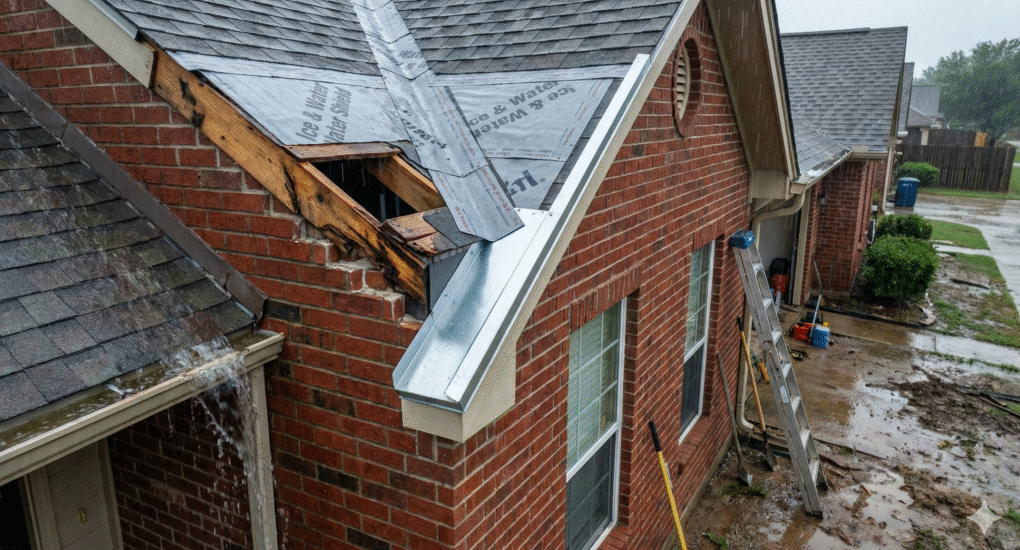
Townhomes share exterior walls with adjacent units. At the point where my roof deck ended and the neighboring unit’s brick wall began, there should have been a metal L-shaped flashing installed to redirect rainwater away from that seam. There was none. Without flashing, every rain event sent water directly into the junction between the roof deck and the brick. The water wicked into the wood framing behind the wall and found a path inside. This is a textbook installation failure, and it falls squarely under HOA exterior maintenance responsibility.
⚠️ The Rafter Problem Nobody Saw Coming
On top of the missing flashing, one of the roof rafters — the structural wood beams that support the roof deck — was cracked and sagging. A sagging rafter changes the geometry of the entire roof surface. Instead of draining toward the gutters as designed, water pooled in a low spot directly above the living area. The accumulated weight eventually forced its way through. Both defects, the missing flashing and the failed rafter, are exterior structural failures. Therefore, both should have been the HOA’s financial responsibility to repair.
⚖️ The HOA Pre-Approval Trap: Why I Lost $4,500
This is the part of the story that still stings. The repairs were legitimate. The damage was real and documented. The CC&Rs clearly assigned exterior maintenance to the HOA. And I still walked away with nothing. Ultimately, the reason was entirely procedural — and entirely my fault for not knowing the rule in advance.
🚫 The Fatal Mistake: Pay First, Ask Later
My tenant was living in the unit. I could not afford to wait for a board meeting, a contractor inspection from the HOA’s approved vendor list, or a formal written authorization letter. I hired the repair team, paid the invoice, and then submitted a reimbursement request with photos, invoices, and a detailed email citing the relevant CC&R provisions. The email went out in December 2025. By January 2026, the board’s answer came back: the board declined the reimbursement request. The stated reason — the owner had obtained no pre-authorization before the work began.
The HOA’s position is that without pre-approval, they have no mechanism to validate the scope of work, verify the contractor, or allocate funds from their budget. From a governance standpoint, that argument is defensible. From the perspective of a landlord with water pouring into a tenant-occupied unit, it is infuriating. But it is the rule.
📋 The Only Rule That Protects Your Claim
Unless the roof is actively collapsing, do not spend a single dollar on what should be HOA-covered exterior work until you have written approval from the board — not a verbal assurance from a management company employee, not an email that says “we’ll look into it.” A formal authorization letter from the board, in writing, before the first nail is pulled. If the board stalls, document every communication. Send follow-up emails with delivery receipts. Keep a running timestamped log. If they deny a legitimate CC&R claim, you will have the paper trail needed to escalate through formal mediation or small claims court. Going forward, I will not touch exterior property without that authorization in hand first.
🛠️ Contractor Strategy: Why the Property Management Team Wins on Price
Once it was clear I was paying out of pocket, the priority shifted to minimizing cost without cutting corners on the repair. That is where having a property management company with an in-house maintenance team delivers a significant financial advantage that most independent landlords never tap into.
💰 In-House vs. General Contractor: The Price Gap
I got quotes from two general contractors first. The numbers were not surprising: high call-out fees, inflated material markups, and labor rates that reflected their full retail margin. Then I asked the property management company whether their in-house maintenance team handled structural roof repairs. They did. Because the team already had an established relationship with the management company, the team charged substantially lower rates — no trip charge premium, no material cost inflation, and hourly labor at a rate I would not find anywhere on Yelp or Angi.
📉 Final Bill: What $4,500 Actually Covered
The final invoice came to approximately $4,500. Specifically, that covered replacement of the damaged rafter, installation of the missing roof flashing, a high-performance waterproofing membrane layer over the repair zone, full interior drywall patching and paint restoration, plus the earlier gutter cleaning and caulking work bundled into the same job. A general contractor would have quoted between $6,000 and $7,000 for the identical scope. Consequently, using the management team’s crew saved me $1,500 to $2,500 on a job I had no choice but to pay for myself. If you own rental property, building that relationship is one of the best operational moves you can make.
I did not get a reimbursement check from the HOA, and that still stings. But the money was not wasted. The root cause is fixed — the rafter is replaced, the flashing is installed, and the waterproofing membrane is in place. I will not be getting another emergency call after the next heavy rain storm in Texas. Furthermore, my tenant’s trust is intact. The quick response, the $100 electricity offset, and the clean repair result told her that I take the property seriously. Retaining a reliable long-term tenant is worth far more than a single month’s rent in vacancy and turnover costs. And the HOA lesson is permanent: written pre-approval before any exterior repair, every single time, no exceptions.
🔗 External Links
- EPA: Mold Growth and the 48-Hour Window
- III: What Homeowners Insurance Actually Covers
- Nolo: How to Resolve HOA Disputes
- This Old House: Roof Repair Guide
- HUD: Landlord Responsibilities