AI Rally: How To Actually Crush Your 2026 Portfolio
⚠️ Investment Disclosure
This article does not promote or recommend buying any specific stock. It is informational content based on publicly available data and personal experience. All investment decisions and risks are solely the reader’s responsibility.
📉 1. March Looks Brutal — And That Is Exactly the Point
The AI Rally looks dead right now. However, smart investors know that fear creates the best discounts. Historically, the S&P 500 averages a return of negative 0.09 percent in March over the past 15 years. Furthermore, the first half of March typically shows flat or downward movement. Then the index strengthens after mid-March consistently.
Additionally, 2026 is a midterm election year. Therefore, the historical pattern matters enormously. Since 1950, midterm years have produced an average intra-year drawdown of 17.5 percent. Specifically, 70 percent of midterm years experience a correction of 10 percent or more. However, the 12 months following that correction average a stunning 16.3 percent gain. Consequently, the current weakness is not a reason to panic. Instead, it is your entry ticket.
🔍 Why March 2026 Hits Differently
Several powerful forces collide this month. The FOMC meets in March to update its dot plot projections. Meanwhile, NVIDIA holds its GTC conference the same week. Therefore, policy uncertainty and AI narrative shifts happen simultaneously. Furthermore, tariff noise and global headline risk add fuel to the volatility fire. The earnings blackout period removes corporate buyback support. Thus, pre-tax-season liquidity crunches magnify every move downward.
🎮 2. The GTC Catalyst — Jensen Huang’s March 16 Keynote
NVIDIA GTC 2026 runs from March 16 through March 19 in San Jose, California. Specifically, CEO Jensen Huang delivers his keynote on March 16 at 11 AM Pacific Time. This four-day event features over 1,000 sessions covering AI data centers, robotics, and digital twins. More than 30,000 attendees from over 190 countries will participate. Thus, GTC is the single most important AI industry event of the year.
Every major GTC keynote in the past five years has moved the stock within weeks. Therefore, investors need to pay extremely close attention to several key announcements. Specifically, watch for the next-generation GPU architecture reveal. Additionally, Blackwell Ultra updates and agentic AI product launches could reprice the entire AI supply chain overnight. The magnitude of GTC announcements determines the AI narrative for the following six months.
📊 Why GTC Matters More Than Earnings
Quarterly earnings merely confirm what already happened. However, GTC creates the forward-looking vision. Jensen Huang does not just report numbers. Instead, he reveals the roadmap that every hyperscaler uses to plan billions in capital expenditure. Therefore, one single keynote presentation can reprice NVIDIA, its suppliers, and its customers simultaneously. Consequently, GTC acts as a massive catalyst for the entire AI Rally thesis.
🏛️ 3. May 15 Changes Everything — New Fed Chair Kevin Warsh
Current Federal Reserve Chair Jerome Powell’s term expires on May 15, 2026. President Trump has nominated Kevin Warsh as his replacement. Furthermore, the formal nomination was submitted to the Senate on March 4, 2026. Warsh previously served as a Federal Reserve governor from 2006 to 2011. He now advocates for lower interest rates. Therefore, this leadership transition could fundamentally shift monetary policy direction.
Markets move on expectations, not just actions. Consequently, the mere anticipation of a dovish Fed chair already influences bond yields and equity valuations. Warsh aligns closely with the current administration’s preference for lower rates and faster economic growth. Thus, the transition represents a powerful structural tailwind for growth stocks and the broader AI Rally.
💰 What Rate Cuts Mean for AI Stocks
AI companies burn massive capital expenditure on data center infrastructure. Therefore, lower interest rates directly reduce the cost of financing these enormous buildouts. Historically, every 25 basis point rate cut has pushed the technology sector up 3 to 4 percent within 60 days. Cheaper capital accelerates the deployment timeline for next-generation AI infrastructure. Consequently, rate cuts act as rocket fuel specifically for AI-focused companies.
⚠️ The Senate Confirmation Wildcard
Senator Thom Tillis has indicated he will oppose any Fed nomination until a Department of Justice investigation is resolved. Therefore, some confirmation delay is possible. However, complete derailment remains unlikely given the current Senate composition. Furthermore, even the uncertainty around Warsh creates forward rate-cut expectations. Thus, markets price in the anticipated policy shift well before any official action occurs.
🚀 4. Summer 2026 — The AI Rally Reignites
After the GTC catalyst lands and the new Fed chair settles in, summer 2026 becomes the inflection point. Specifically, hyperscalers like Microsoft, Google, and Amazon begin deploying products announced at GTC. Therefore, revenue acceleration shows up in Q2 and Q3 earnings reports. Meanwhile, the new monetary policy direction under Warsh creates a favorable environment for risk assets across the board.
The convergence of these forces creates the ideal conditions for the AI Rally to reignite with full momentum. Corporate AI spending continues accelerating globally. Government deregulation under the current administration removes friction from the buildout process. Thus, the summer of 2026 may mark the beginning of the second major leg of the AI infrastructure supercycle.
📈 The Midterm Election Tailwind
Historical data strongly supports this thesis. The S&P 500 has never posted a negative return in the October-to-October period following midterm elections since 1939. Furthermore, the six-month window from November through April has historically averaged a 14 percent gain. Therefore, the current volatility and dips before November represent a statistically proven buying opportunity. Smart money accumulates during exactly this type of uncertainty.
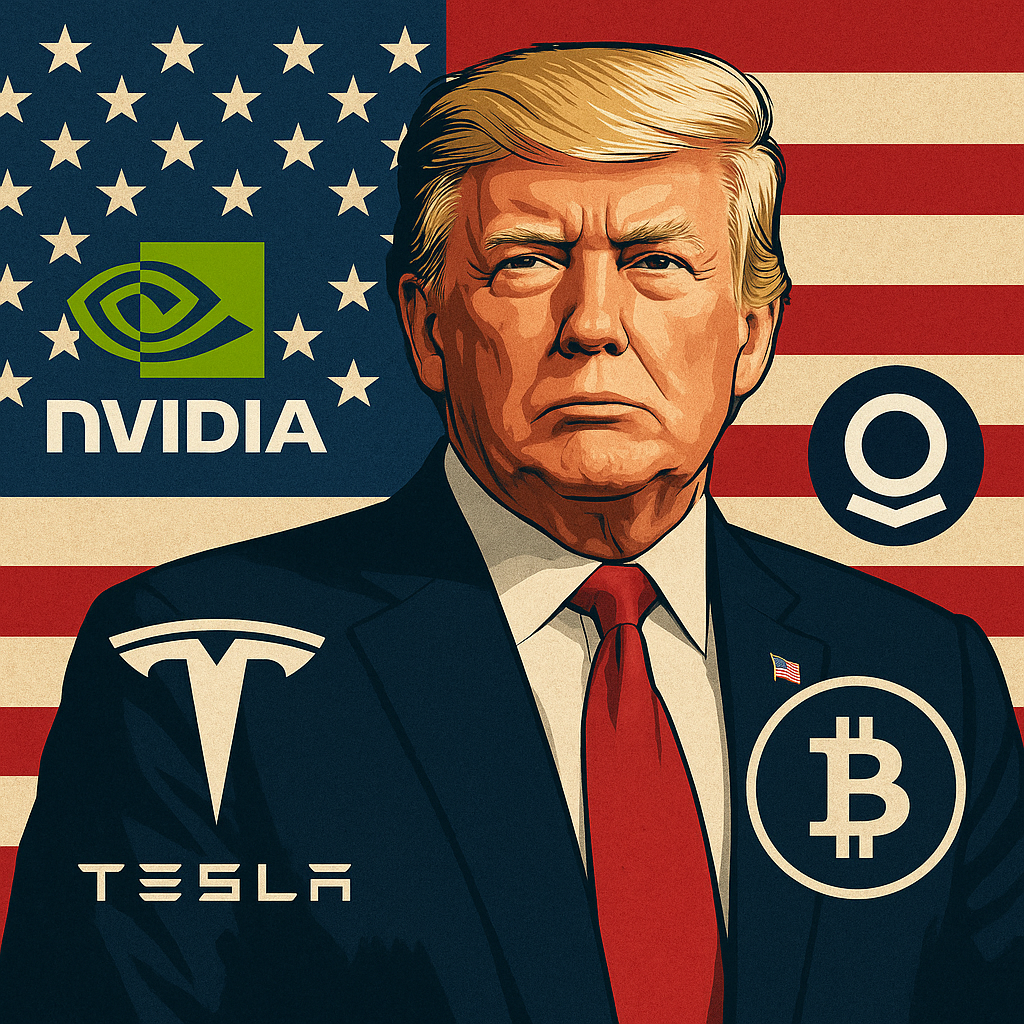
🎯 5. The Four Pillars — NVDA, TSLA, PLTR, and Bitcoin
The current administration’s policies directly fuel each of these four assets. AI deregulation benefits NVIDIA. Autonomous driving regulatory rollbacks fast-track Tesla’s FSD and robotaxi ambitions. Defense spending and government efficiency contracts flow to Palantir. Pro-crypto executive orders legitimize Bitcoin.
I hold all four of these assets. They make up roughly 70 percent of my total portfolio across both my Robinhood brokerage account and my Roth IRA. The remaining 30 percent includes SoFi, IonQ, Zeta Global, Amazon, Palo Alto Networks, Ondas Holdings, and NuScale Power. Day trading is not part of my strategy. Call and put options have no place in my portfolio. Instead, my approach is purely long-term — no panic selling, no rebalancing on noise.
After 11 years at a Fortune 50 IT company and 3 years at a global consumer electronics firm, both in supply chain management, I see enterprise AI adoption from the inside every single day. From that vantage point, these four companies are not optional holdings. They are essential. Each one dominates its category with no true rival in sight. In the current geopolitical landscape under this administration, they are directly tied to America’s technological survival and future. When I look 10, 20, or even 30 years ahead, no other stocks give me this level of conviction.
🟢 NVIDIA (NVDA) — The AI Infrastructure Monopoly
NVIDIA controls over 80 percent of the AI training GPU market globally. The Blackwell architecture ramp is driving record-breaking margins quarter after quarter. Furthermore, every major cloud provider is their customer. Microsoft, Google, Amazon, and Meta all compete fiercely to secure NVIDIA allocation. GTC 2026 will reveal the next-generation roadmap that determines AI infrastructure spending for years. Additionally, the current administration removed the previous AI executive order restrictions. Therefore, there is no regulatory ceiling on AI buildout in the United States.
🔴 Tesla (TSLA) — The Optimus and FSD Wildcard
Tesla operates at the intersection of AI, energy, and transportation. Elon Musk’s role in the Department of Government Efficiency gives Tesla a direct policy pipeline to the administration. Furthermore, Full Self-Driving supervised mode continues expanding to new markets. The Optimus humanoid robot program represents a massive asymmetric long-term bet. Additionally, the robotaxi service launch timeline could fundamentally re-rate Tesla from a car manufacturer to an AI platform company. That transformation alone could justify multiples far beyond current levels.
🔵 Palantir (PLTR) — The Government AI Operating System
Palantir dominates defense and intelligence AI contracts with unmatched depth. The Artificial Intelligence Platform commercial adoption is exploding across private enterprises. Meanwhile, the defense budget increased software and AI spending by 15 percent year over year under the current administration. Palantir is the most direct beneficiary of this structural shift. Furthermore, the February stock price decline created an attractive entry point at a meaningful discount. The company has no peer that matches its combined government clearance level and commercial AI deployment capability.
🟡 Bitcoin (BTC) — The Digital Reserve Asset
The current administration signed pro-cryptocurrency executive orders within the first months of the term. The SEC has shifted from aggressive enforcement to constructive guidance. Strategic Bitcoin Reserve discussions are actively happening in Congress. Furthermore, federal rate cuts historically supercharge cryptocurrency markets. The 2020 rate-cut cycle proved this pattern decisively. Additionally, quantum computing fears remain vastly overblown. Current technology is decades away from threatening SHA-256 encryption. Bitcoin continues its institutional adoption trajectory with increasing momentum.
🧭 6. Conclusion — Buy the Fear, Ride the Wave
March pain is temporary. The structural catalysts ahead are enormous. NVIDIA GTC reshapes the AI narrative on March 16. A new dovish Fed chair arrives on May 15. Midterm election year patterns historically deliver massive rallies after November. These are not speculative hopes. They are data-driven probabilities backed by decades of market history.
Do not wait for perfect conditions. Perfect conditions never arrive. Instead, buy when others hesitate. Accumulate quality assets during periods of maximum fear. The four pillars of NVDA, TSLA, PLTR, and Bitcoin collectively represent the best long-term conviction portfolio for the decade ahead. Marry the asset. Date the rate. The AI Rally of 2026 is not over. It has barely begun.
🔗 External Links
- NVIDIA GTC 2026 Official Page
- Federal Reserve Economic Data — Fed Funds Rate (FRED)
- US Bank: Stock Market Performance in Election Years
- Forbes: Trump Picks Kevin Warsh for Fed Chair