April Stock Market: History Says Buy, 2026 Says Wait
⚠️ Investment Disclaimer: This post is for informational purposes only and does not constitute financial advice or a recommendation to buy or sell any security. All investment decisions are made at your own risk.
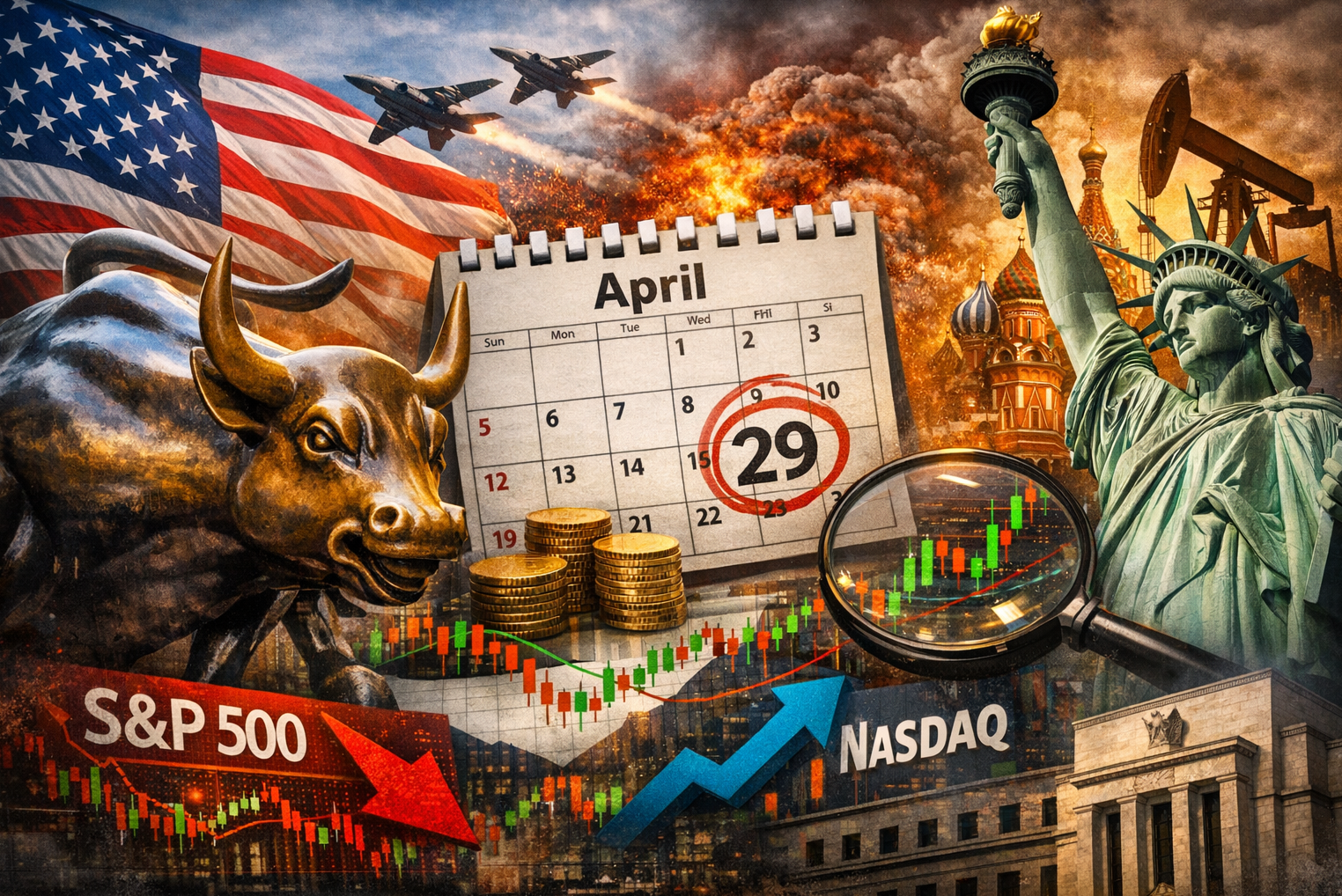
The April stock market has a long reputation for strength — and historical data backs it up. However, 2026 arrives with a fundamentally different setup. Effective tariffs sit at multi-decade highs, a Middle East conflict is pushing oil past $100 per barrel, and a Fed that cannot afford a dovish mistake. Seven major events stand between today and May 1, and each one carries real market-moving potential.
Here is what the data says about April historically, what is left on the calendar, and how this month could realistically end.
📅 April Stock Market History: Numbers That Matter
📊 S&P 500 in April: A 70% Win Rate
Over the last 30 years, the S&P 500 has averaged a gain of +1.5% to +1.6% in April. That ranks it among the top two months of the year by average return. In the last decade, seven out of ten Aprils closed positive — a 70% win rate. The range is wide: +9.4% in April 2020 and -8.8% in April 2022.
The broader November-to-April window tells an even stronger story. That six-month period finished positive 85% of the time over the last 20 years, averaging +7.1%. By contrast, the May-to-October stretch lagged significantly at just +1.4% average return. The “Sell in May” principle is not just market folklore — the long-term data fully supports it.
📈 Nasdaq in April: Bigger Moves, Both Ways
The Nasdaq amplifies the April trend in both directions. Its best April on record came in 2009 at +14.1%, as the Fed’s crisis-era liquidity finally reached full velocity in markets. April 2020 added +12.7% during the post-COVID recovery rally. On the other side, April 2022 delivered -8.8% as the Fed pivoted sharply into rate hikes.
Historically, the Nasdaq’s April result has come down to two questions: Is the Fed cooperative? Are big tech earnings delivering real numbers? In 2026, both questions remain wide open — and that uncertainty is precisely why the April stock market is more unpredictable than usual this year.
🗓️ The April Stock Market Calendar: What Is Still Ahead
📉 This Week (April 6–10): The Inflation Gauntlet
April 6 brings the ISM Services PMI, which covers roughly 80% of U.S. GDP. Any surprise here will move markets immediately. On April 7, Fed Vice Chair Jefferson speaks on the economic outlook and the labor market, and Governor Barr follows on AI and consumer issues. Two Fed voices on the same day is worth tracking closely.
4/8 releases the FOMC minutes from the March 17–18 meeting — markets will dissect every line for rate path signals. April 9 then delivers the February PCE price index and the final Q4 GDP reading. April 10 is the week’s real climax: March CPI and the University of Michigan Consumer Sentiment Index drop on the same morning. Specifically, a hot CPI reading on April 10 is the single most market-disruptive data point of the entire week.
💼 April Stock Market Earnings: Banks Lead, Big Tech Closes
Earnings season opens April 13 with Goldman Sachs Q1 results before the open. April 14 then brings JPMorgan Chase, Citigroup, Bank of America, Wells Fargo, and the March PPI all in one session. Bank guidance on credit conditions and loan demand will set the tone for the entire season. ASML reports and the Fed Beige Book arrive on April 15.
Netflix reports during the week of April 20. Tesla (TSLA) Q1 results are estimated around April 22. Furthermore, April 29 stacks nearly every major catalyst at once: Alphabet, Meta, Microsoft, and SoFi (SOFI) all report earnings. That same afternoon, the FOMC rate decision and Powell’s press conference land simultaneously. Apple and Amazon close out the month on April 30. Note that Palantir (PLTR) reports May 5 and Nvidia (NVDA) reports May 27 — both fall outside the April window.
🏦 FOMC April 28–29: The Language Matters More Than the Rate
Markets have already priced in a rate hold at this meeting. Moreover, Fed Governor Cook stated in late March that “inflation risks are now higher” than employment risks — a direct signal against a near-term pivot. With tariff-driven inflation still unresolved, the Fed has very limited room to signal cuts without losing credibility.
The real April stock market test comes at Powell’s press conference on April 29. A hawkish tone — “we are not in a hurry to cut” — sends equities lower on the spot. A neutral read — “we remain data-dependent and flexible” — keeps the door open for a relief rally into May. At 2:30 p.m. ET on April 29, that first sentence matters more than the rate decision itself.
⚡ Three Risks That Could Flip the Script
🔥 Tariffs: 11.7% Effective Rate, Months of Uncertainty Still Ahead
The effective U.S. tariff rate jumped from 2.1% to 11.7% in early 2026. After the Supreme Court struck down the “Liberation Day” tariffs, the administration deployed a 15% bridge tariff under Section 122 of the Trade Act, valid for 150 days through July. Retail, automotive, and pharmaceutical companies are already restructuring supply chains in response. This overhead does not lift in April — it presses on markets all the way through summer.
On April 4, the S&P 500 bounced 2.9% on a single minor diplomatic headline. That reaction reveals how fragile and headline-sensitive current market sentiment is. As a result, high-volatility conditions are likely to persist throughout this month, with sharp intraday swings in both directions.
🛢️ Oil Above $100 and the Inflation Trap
An Iran conflict that erupted in late February disrupted the Strait of Hormuz — the chokepoint for roughly 20% of global oil supply. Brent crude and WTI jumped to $105–$120 per barrel. Higher energy costs feed directly into consumer prices and producer margins. If oil stays elevated into mid-April, the CPI print on April 10 could easily surprise to the upside.
A hot CPI read triggers a painful chain reaction: inflation re-acceleration leads to prolonged rate holds, which in turn compresses equity valuations and crushes rate-sensitive sectors. Meanwhile, the Fed’s options narrow with every barrel above $100. This is one of the most underappreciated risks sitting on the April calendar right now.
💡 AI Stocks Still Need Proof, Not Just Promises
Nvidia, Palantir, and other AI-linked names have pulled back from highs but still trade at historically elevated valuations. Justifying those prices requires big tech earnings to show actual AI-driven revenue — not just capital spending roadmaps. Investors are losing patience with “we’re investing heavily” narratives without matching revenue growth to show for it.
Google Cloud Next 2026 runs April 22–24, with Alphabet expected to present real-world AI agent deployment data and Gemini model enterprise traction. That conference could reset sentiment across the entire AI trade heading into the May earnings cycle. In short, April is the month where AI valuations either start to earn their premium or face a sharper reckoning.
🔭 Two Scenarios for the Rest of April
🟢 Bull Case: Earnings Beat, Powell Stays Neutral
Bloomberg Intelligence forecasts S&P 500 Q1 earnings growth of 11.9% year-over-year. If financials and mega-cap tech beat those estimates, and Powell delivers a non-threatening press conference, the April stock market could stage a meaningful recovery. Seasonal tailwinds support this case — the historical 70% win rate for April is real context, not noise. A technical recovery toward the 200-day moving average is achievable, representing a potential +3% to +5% gain from current levels.
🔴 Bear Case: Tariffs Escalate, CPI Surprises Hot
Trump’s China visit, planned for May 14–15, could fall apart entirely. A tariff escalation announcement would reignite trade war fears across every major sector simultaneously. Additionally, a hot CPI on April 10 would extinguish any remaining 2026 rate cut expectations. If Tesla or SoFi disappoint on earnings, individual stock pain layers on top of the macro pressure. In this scenario, VIX could push past 30 and the S&P 500 faces an additional 5–8% decline before month-end.
💬 TSLA, NVDA, PLTR, SOFI, BTC — April Watchlist
For anyone holding these five names, two dates define the month: April 22 for TSLA results and April 29 for SOFI results plus the FOMC decision. Tesla faces persistent China tariff pressure and softening EV demand heading into its Q1 report. Delivery data and gross margin defense are the numbers that matter. Strong China factory output could trigger a meaningful reversal, while weak numbers likely push the stock to the $200 range or below.
SoFi reports before the open on April 29 at approximately 7:00 a.m. ET. Prolonged high rates pressure the lending business, but deposit growth and member expansion can offset some of that drag. As for Palantir, it reports May 5 — therefore, April is essentially a “track the narrative” month for PLTR. AI government contract momentum and commercial segment growth are the signals worth watching as the April stock market develops.
Nvidia stays quiet until May 27. Indirectly, it will react to big tech’s AI infrastructure spending guidance and any news on export control changes. Bitcoin’s correlation to equities remains elevated in this environment. VIX spikes create near-term BTC downside pressure, but the post-halving medium-term structure stays bullish. Across this entire watchlist, patience — not action — is the right posture right now.
🔗 External Links
- Federal Reserve April 2026 Calendar
- Finviz Earnings Calendar
- Investing.com Economic Calendar
- StatMuse Nasdaq Monthly Returns
- Stock Market Seasonality Patterns