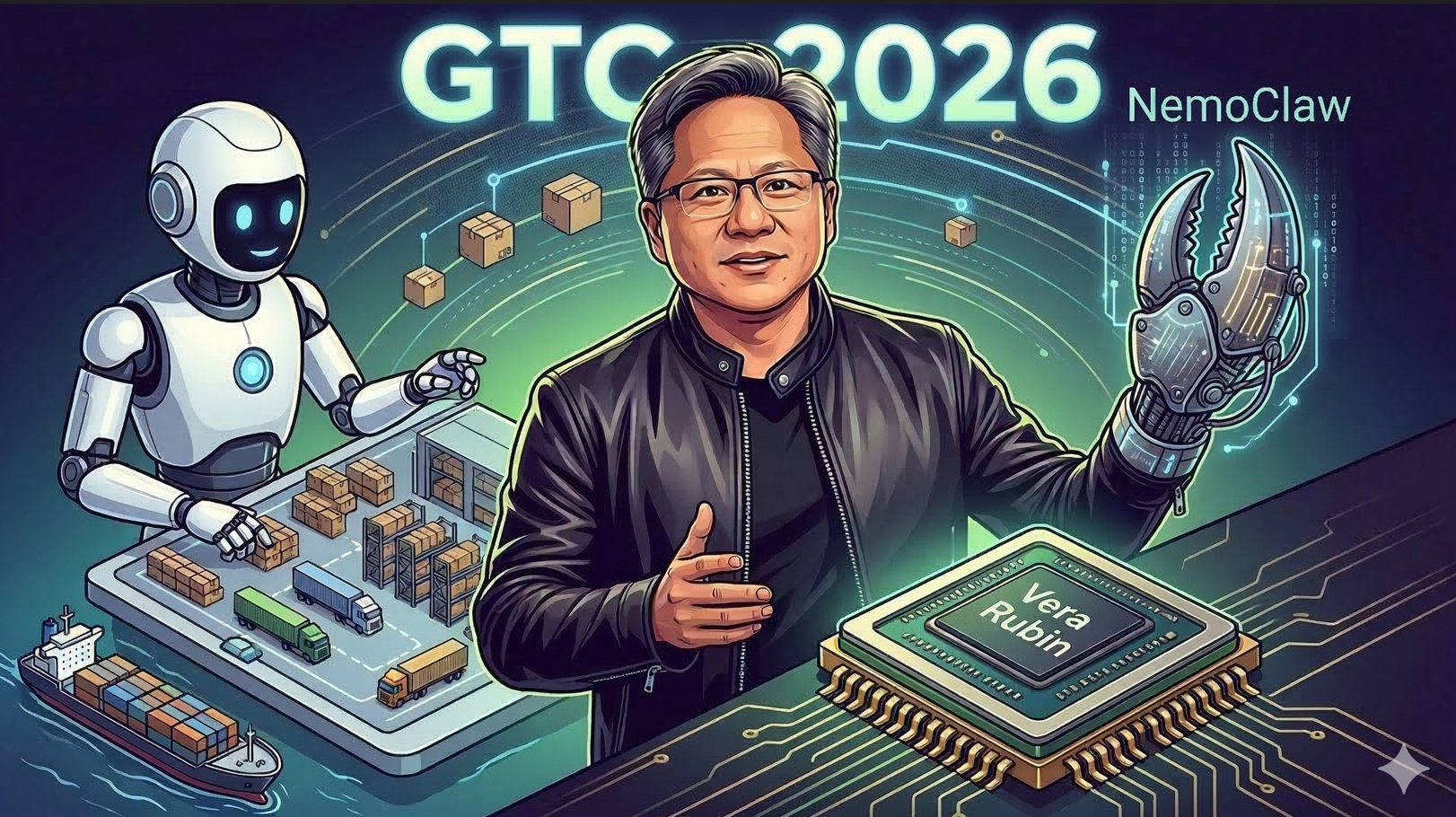
GTC 2026: How Staggering New Tech Will Shape Your Future
🚀 GTC 2026 Keynote: The Core Vision of NVIDIA
💡 A Long-Term Investor’s Perspective on the Paradigm Shift
🔍 From Digital Thought to Physical Action
On March 16, 2026, the global technology landscape witnessed a historic milestone. Specifically, this occurred during the NVIDIA GTC 2026 event in San Jose, California. CEO Jensen Huang’s keynote address was far more than a routine product showcase. Instead, it served as a definitive declaration that humanity is fundamentally altering its relationship with artificial intelligence.
As a long-term investor, I have held NVIDIA stock through years of market volatility. Consequently, watching this presentation provided an unprecedented level of conviction. For a long time, Wall Street and mainstream media focused intensely on raw computational speed, specifically looking at GPU metrics and the parameter counts of large language models (LLMs).
However, the core narrative Huang introduced this year changed the conversation entirely. He clearly stated that AI has evolved past generating text and images on screens. We have now entered the era of physical AI. In this era, artificial intelligence can natively understand complex physical laws and autonomously operate within the real world.
💰 Entering a $1 Trillion GTC 2026 Infrastructure Market
From a strict value investing standpoint, GTC 2026 proved a vital point. It showed that NVIDIA is no longer just a semiconductor design company. Rather, they have successfully transitioned into a foundational operating system. They are now the primary platform provider for the entire fourth industrial revolution.
As Huang repeatedly emphasized, the world is at a major turning point. We are at the beginning of a $1 trillion global AI infrastructure rebuild cycle through 2027. Moreover, while macroeconomic uncertainties may cause temporary stock market fluctuations, the underlying trend remains intact.
In fact, global Fortune 500 companies are pulling massive capital expenditure (CapEx) into NVIDIA’s ecosystem. This happens like a black hole pulling in light. This unstoppable momentum provides long-term investors with a logical justification to maintain a heavy portfolio weighting in this sector, ignoring short-term market noise.
💻 Vera Rubin and the GTC 2026 Infrastructure Stack
⚡ The Birth of the Agentic AI Infrastructure Stack
🔄 Mastering the Economics of High-Speed Inference
The most immediate shockwave sent through the IT industry was the release of the Vera Rubin platform specifications. Additionally, the revelation of NVIDIA integrating Groq 3 LPX inference accelerator racks into the Rubin platform massively amplified this announcement.
The previous Blackwell architecture demonstrated absolute dominance in training massive datasets. By contrast, the design philosophy behind Vera Rubin is entirely different. This new architecture focuses on maximizing the economic efficiency of inference, which is the process of applying trained models to live B2B and B2C services.
Above all, industry experts hail Jensen Huang’s decision to bring the Groq 3 LPX architecture into the ecosystem. This move represents a masterstroke for ultra-low latency. By fusing this technology with Samsung’s HBM4 and GDDR7, NVIDIA has effectively eliminated notorious memory bottlenecks that previously plagued traditional GPU structures.
📉 Dramatic CAPEX Reductions for GTC 2026 Enterprises
This unprecedented fusion of hardware architectures has exponentially increased token generation speeds. Notably, this goes far beyond the simple metric of faster data processing.
It delivers massive economic benefits to global enterprise companies. These firms must process colossal amounts of customer and operational data in real-time. Specifically, the Vera Rubin platform reshapes corporate IT budgets by lowering power consumption and maintenance costs.
Consequently, enterprises can now execute tens of thousands of complex AI reasoning tasks using the exact same budget allocations as before. This leap in efficiency, powered by the new Dynamo 1.0 inference OS, will act as a primary catalyst for bringing highly advanced, autonomous AI services to the mass market much sooner than anticipated.
🤖 Introduction of NemoClaw: A GTC 2026 Reveal
🏢 The Game Changer for Enterprise Agentic AI
🛡️ Secure and Sandboxed Digital Workers
The hardware innovations were truly breathtaking. However, the software announcements made at GTC 2026 carry equal weight for the corporate world. The official debut of NemoClaw is set to completely disrupt the enterprise software market.
NVIDIA developed NemoClaw as an industrial-strength agent stack built on the OpenClaw vision. This new software framework features a zero-compromise approach to security. As a result, it prioritizes corporate security and operational autonomy by using NVIDIA’s own NemoTron models.
Companies can leverage NemoClaw to deploy autonomous AI agents within fortified environments. On the other hand, traditional public cloud-based AI tools have always terrified conservative boards. They fear the risk of leaking sensitive customer data. NemoClaw solves this by guaranteeing absolute data sovereignty on-premises through a dedicated agent control layer.
📊 GTC 2026: Beyond Passive Chatbots
🔄 True Process Automation in the Enterprise
For the past few years, the corporate world has used generative AI as passive chatbots. You type a prompt, and the AI gives you a response. In contrast, NemoClaw operates on a fundamentally different logic.
When a manager assigns a strategic goal to a NemoClaw agent, it acts independently. It autonomously breaks that goal down into a multi-step execution plan. Then, it securely accesses internal ERP systems and financial software, extracting necessary data and completing the task from start to finish.
The results are explosive when you combine enterprise security with Vera Rubin hardware and the new Vera CPU. Indeed, NemoClaw functions as an untiring digital worker. It quietly reconciles fragmented departmental data overnight and places a highly accurate analytical report on an executive’s desk by the morning.
🏭 GTC 2026: Physical AI Driving Supply Chain Innovation
🌐 A 14-Year SCM Veteran’s Direct View
📦 Tectonic Shifts in the Fortune 50 Operating Model
I have managed global supply chain operations for a Fortune 50 corporation for over 14 years. From my perspective, the true climax of GTC 2026 was not the silicon. Instead, it was the evolution of physical AI breaking out of digital simulations and entering real-world industrial facilities.
During the keynote, Huang demonstrated Project Alpamayo’s advanced autonomous capabilities. He also showed articulate bipedal robots powered by the Isaac platform. In particular, these robots were not just a theatrical display for shareholders.
This technology represents the ultimate master key to solve the chronic bottlenecks currently suffocating inland logistics networks. Above all, it is a direct solution to skyrocketing labor costs and structural workforce shortages that currently plague modern fulfillment operations.
📉 Taming the GTC 2026 Bullwhip Effect
Modern multinational supply chain management is a daily battle against deep uncertainty. For example, even a microscopic shift in consumer demand can create a massive, uncontrollable wave. This wave travels upstream to raw material suppliers.
Corporations are currently forced to hoard massive amounts of safety stock to control this bullwhip effect. Unfortunately, this antiquated strategy traps billions of dollars in working capital inside dusty warehouses.
Furthermore, finding reliable human labor in large fulfillment centers is a daily nightmare. High turnover rates and worker burnout lead to unacceptably high error rates in the picking and packing processes. This remains the most painful operational headache for 임의의 logistics manager today.
⚙️ GTC 2026: Autonomous Crisis Response
The integration of NemoClaw and physical AI robotics completely rewrites the rules of SCM. Consider, for example, a scenario where severe typhoon conditions delay a massive cargo ship.
In a legacy environment, a human SCM manager would log into a slow ERP system and discover the delay only after hours of tracing data. Consequently, the manager would spend frantic hours sending emails to foreign forwarders and manually rewriting complex factory schedules on Excel spreadsheets. This archaic response inevitably causes days of delays and millions in lost revenue.
🚚 Real-Time Predictive Orchestration in Action
However, in a post-2026 environment, NemoClaw SCM agents change everything. These intelligent digital workers monitor global maritime weather and ship GPS coordinates 24/7 in the background.
The agent initiates an autonomous contingency plan the moment a delay risk crosses a threshold. Specifically, it does this without waiting for human approval. The agent instantly calculates the financial cost of securing emergency air freight from a nearby airport.
If the cost falls within pre-approved parameters, the agent executes the contract immediately. Simultaneously, it sends commands to the overseas factory’s robotics control tower, autonomously resequencing the assembly line to prioritize products using available parts.
🤖 GTC 2026: Achieving Zero-Downtime Warehouses
This entire complex crisis resolution is finished before the human manager even finishes his morning coffee. Indeed, this is the most chillingly impressive aspect of the technology.
Past SCM systems merely analyzed historical data to predict an uncertain future. By contrast, the next decade defined by NVIDIA focuses on systems that react to physical variables and execute self-healing actions instantly.
Inside the warehouse, humanoid robots will communicate with Vera Rubin servers in milliseconds. They will autonomously calculate the safest, most efficient travel paths, avoiding collisions with peers. Eventually, the deployment of physical AI will drive facility downtime to near absolute zero, triggering a historic quantum leap in operating profit margins.
📈 GTC 2026: Long-Term Technical Moat and Value
🎯 The Fundamental Strategic Outlook
🥇 The Trinity of Hardware, Software, and Physics
In conclusion, GTC 2026 allowed NVIDIA to carve its dominance into the bedrock of technology. They have proven they are not merely a fabless semiconductor company reliant on TSMC.
Rather, NVIDIA has evolved into the central nervous system for the industrial revolution. They introduced Vera Rubin for unmatched computation and built NemoClaw for enterprise command and control.
Finally, they brought robotics and physical AI under the same ecosystem umbrella, allowing digital intelligence to directly manipulate the physical world. Currently, NVIDIA stands alone as the only corporation to unify hardware, software, and physical world interaction on this scale.
💎 GTC 2026: Focus on Real Economic Moats
The stock market is a living entity and will experience violent price swings. Certainly, the greed and fear of retail traders will always create volatility.
However, an outstanding business derives its permanent value from its economic moat. The cold reality is that massive industrial conglomerates are lining up to enter the NVIDIA ecosystem. My own Fortune 50 company is among them.
They are willingly paying exorbitant fees to modernize their aging supply chains and maximize productivity. In fact, the financial figures in every quarterly report clearly prove this frantic adoption.
A true visionary investor must not let daily price fluctuations dictate their emotions. Instead, they must focus on the massive wave of infrastructure innovation. Now is the perfect time to anchor your long-term portfolio with absolute conviction in the disruptive, real-world corporate value generated at the center of this technological hurricane.
🔗 External Links
- NVIDIA GTC AI Conferences For Developers – https://www.nvidia.com/gtc/events/
- Groq 3 LPU, Vera CPU, DLSS 5: Every major announcement from Jensen Huang’s keynote at Nvidia GTC 2026 – https://indianexpress.com/article/technology/artificial-intelligence/every-major-reveal-nvidia-gtc-2026-jensen-huang-keynote-10586373/
- Nvidia GTC 2026: What to expect from Jensen Huang’s keynote including next-gen GPUs, Groq deal – https://indianexpress.com/article/technology/artificial-intelligence/nvidia-gtc-2026-what-to-expect-jensen-huang-keynote-10584907/
- Nvidia GTC 2026 live: ‘It all starts here’ – all the day one news and updates from the Jensen Huang keynote – https://www.techradar.com/pro/live/nvidia-gtc-2026-live-coverage-all-the-news-and-updates-as-it-happens